Turning Data Centre Waste Heat into a Resource for Energy Transition
How Sino-German cooperation helps integrate fast-growing digital infrastructure into low-carbon heating systems
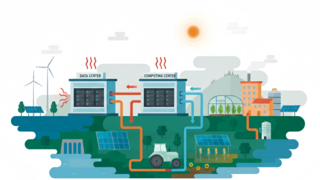
Data centres are among the fastest-growing electricity consumers worldwide as they expand rapidly to support digital economy. At the same time, the large volumes of waste heat generated by cooling systems offer an untapped resource for low-carbon heating. A Sino-German dialogue held on 21 January 2026 brought together more than 50 experts from China and Germany to explore how policy frameworks, technologies and business models can turn data centre waste heat into a contribution to decarbonisation, energy efficiency and sustainable urban development.
The Challenge: Digital Growth and Energy Transition
Globally, data centres already account for around 1.5% of electricity consumption, with annual growth rates of approximately 20%. As computing capacity expands, so does the amount of waste heat produced—often released unused into the environment. Harnessing this heat is increasingly relevant for decarbonising heating systems, improving overall energy efficiency and reducing emissions from urban energy supply. Integrating data centres into broader energy and heat planning has therefore become a strategic issue at the intersection of digitalisation, climate policy and energy security.
Why Cooperation on this Topic Matters?
Waste heat utilisation from data centres is a systemic challenge that no country can solve in isolation. Germany brings experience with binding regulation, municipal heat planning and market-based instruments for waste heat integration. China contributes scale, rapid deployment, and technological innovation in high-density computing and cooling technologies. Cooperation allows both sides to learn how different policy and market conditions influence implementation and how solutions can be adapted to diverse urban and climatic contexts—strengthening the global energy transition while supporting economic development.
Objective
The dialogue aimed to exchange policy experience, technical solutions and economic models for data centre waste heat utilisation, identify barriers to scaling up implementation, and assess how Sino-German cooperation can accelerate market development and policy learning in both countries.
Action Taken
Co-hosted by Deutsche Gesellschaft für Internationale Zusammenarbeit GmbH (GIZ), the German Energy Agency (dena), the China Electric Power Planning & Engineering Institute (EPPEI) and the Sichuan Tianfu Yongxing Laboratory, the online workshop convened policymakers, researchers, data centre operators and energy experts from both countries. Presentations and roundtable discussions focused on regulatory frameworks, technical pathways such as liquid cooling, and business models for integrating waste heat into district heating systems.
Results and Insights
The exchange highlighted both the potential and the constraints of waste heat utilisation:
- In China, policy-driven pilots supported by liquid cooling technologies are improving heat quality and enabling reuse. Waste heat revenues of approximately 0.07–0.4 CNY/kWh were reported, with both energy efficiency and economic performance improving as projects scale up.
- In Germany, binding requirements under the Energy Efficiency Act (EnEfG) mandate minimum waste heat reuse rates for new data centres from 2026 onwards, embedded in municipal heat planning and transparency platforms. With more than 2,000 data centres nationwide, this framework aims to unlock significant heat potential by 2030.
At the same time, experts from both countries identified shared challenges. Low-temperature waste heat often requires heat pumps and additional infrastructure, leading to high upfront costs and payback periods frequently exceeding five years. Seasonal heat demand, regulatory barriers and limited coordination between data centre operators and urban heating planners further constrain large-scale deployment.
From Results to Systemic Impact
Despite these barriers, the dialogue showed potential pathways for scaling up. In China, stricter power usage effectiveness (PUE) requirements, rising electricity prices and corporate carbon-neutrality commitments are strengthening the business case. In Germany, early-stage integrated planning and ecosystem-based approaches—linking data centres, municipalities and heat network operators—are improving supply–demand matching. Together, these experiences demonstrate how waste heat utilisation can evolve from pilot projects to a structural element of low-carbon energy systems.
Next Steps
Participants envisioned to deepen Sino-German cooperation through continued policy dialogue and exchange on current developments. Another round of exchange is planned after the soon expected amendment of the German Energy Efficiency Act and the development of the National Data Center Strategy.
This dialogue is organised under the framework of the Sino-German Energy Transition project “EnTrans”, a component focusing on think tank cooperation of the Sino-German Energy Partnership supported by the German Federal Ministry for Energy and Economic Affairs (BMWE).